ARGUS: Aerodynamic Workflow for Morphing Wings
Open research software for reproducible geometry generation, aerodynamic analysis, and constrained optimization of adaptive wings.
Key contributions
- Developed the geometry-generation, aerodynamic-analysis, and constrained-optimization workflow.
- Compared rigid, conventional hinged, continuous trailing-edge camber, and distributed twist concepts at matched operating conditions.
- Audited induced-drag metrics, geometry interpolation, units, and result provenance to establish traceable comparisons.
- Delivered documented software, selected geometries, tests, and interfaces for future multidisciplinary coupling.
Liming's role: Lead developer and aerodynamic optimization researcher; planned first author of the associated SoftwareX submission.
From morphing concepts to reproducible evidence
Aircraft wings must operate across changing flight conditions. ARGUS investigates adaptive morphing surfaces for more sustainable aviation. During a short-term postdoctoral project at TU Delft from April to October 2026, Liming developed a reusable aerodynamic design workflow to investigate how the outer wing should adapt during cruise.
The software compares four concepts on a common NASA/OpenVSP reference wing: a rigid baseline, conventional two-segment hinged control surfaces, continuous trailing-edge camber morphing, and distributed twist morphing. Each candidate is trimmed to the required lift before its induced drag and spanwise loads are compared.
A reusable software framework
The Python workflow connects explicit .vsp3 geometry generation, OpenVSP/VSPAERO evaluation, fixed-lift trim, surrogate-assisted candidate search, and strict solver reruns. Saved native outputs and geometry provenance keep each selected result traceable. Surrogate predictions propose new candidates; final reported results come from solver evaluations.
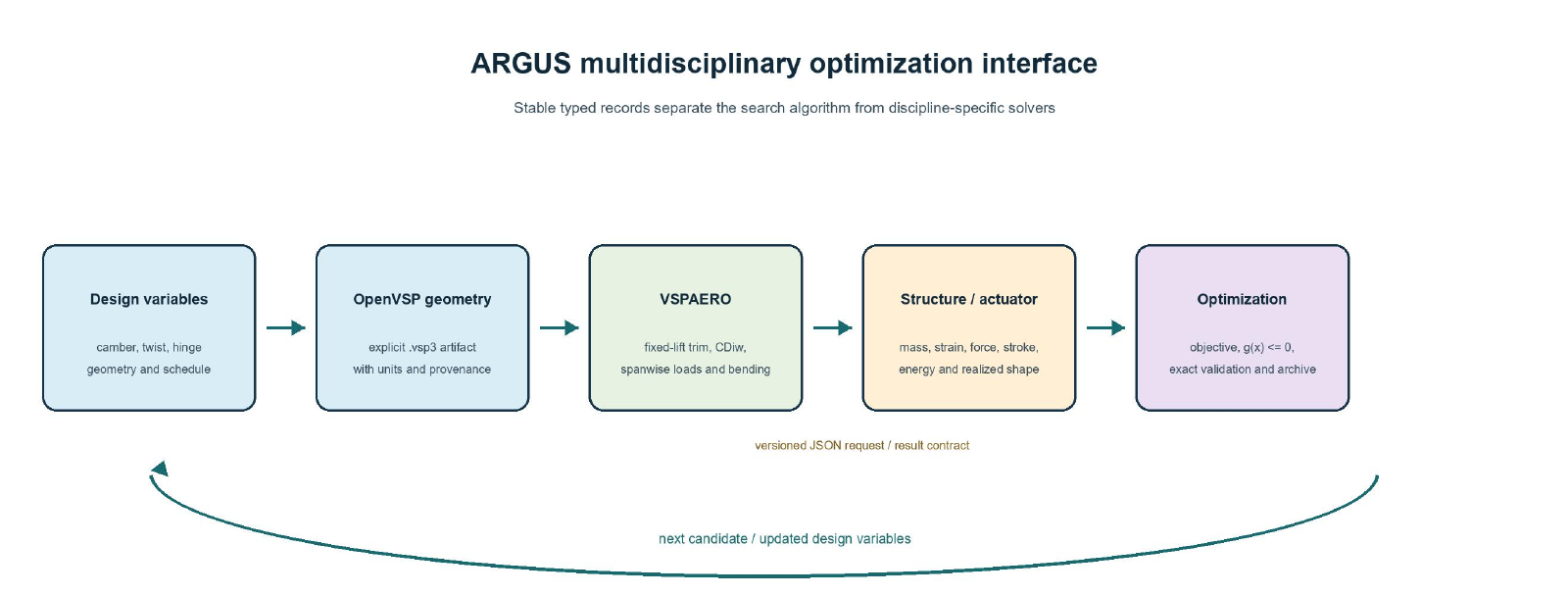
The versioned interface supports future structural and actuator coupling. The aerodynamic study does not yet constitute a fully validated coupled aeroelastic design.
Typed evaluation records and versioned JSON contracts separate geometry generation, aerodynamic evaluation, structural assessment, and optimization. This allows subsequent researchers to connect a structural model or replace the search algorithm while retaining the aerodynamic analysis pipeline. The Python orchestration interface is tested on Windows, Ubuntu, and macOS; OpenVSP/VSPAERO requires a separate installation and baseline verification.
Selected aerodynamic findings
The current cruise audit covers 102 geometries, 204 independently trimmed flight-state evaluations, and 816 native VSPAERO output files. Final induced-drag comparisons use the native wake/Trefftz-plane coefficient, CDiw.
| Concept | Early-cruise induced-drag reduction | Late-cruise induced-drag reduction |
|---|---|---|
| Conventional hinged | 0.064% | 2.121% |
| Continuous trailing-edge camber | 1.424% | 4.302% |
| Distributed twist | 1.031% | 4.313% |
Relative to the rigid wing at the same operating point, at Mach 0.78, with independently trimmed lift and a shared illustrative half-wing root-bending limit.
Trailing-edge camber provides the best early-cruise result in the current database. The two continuous concepts are effectively tied at late cruise; their small difference does not establish a robust hardware winner. Scheduled adaptation also matters: the late-optimized continuous shapes exceed the early-cruise bending screen when retained unchanged.
These are low-order, wing-only induced-drag predictions, not measured reductions in total aircraft drag or fuel consumption. Transonic shocks, viscous and profile drag, aeroelasticity, mechanism mass, and actuator energy require further assessment. The bending limit is a study assumption rather than a certified structural allowable.
Open source and planned publication
The ARGUS Aerodynamic Workflow repository provides the code, documentation, audited summaries, selected geometries, tests, and extension interfaces. Original software and documentation are released under the BSD 3-Clause License. Third-party software, NASA-derived material, collaborator-owned data, geometry, and institutional branding retain their original terms.
An associated software paper is planned for submission to SoftwareX, with Liming Zheng as planned first author. This is a publication plan; the manuscript is not listed here as submitted, accepted, or published.
Project context and acknowledgements
This work was developed at Delft University of Technology within ARGUS — Adaptive and Responsive Morphing Surfaces for Green Aviation Using Shape Memory Alloys, under Work Package 1: Modelling and Simulation, specifically Task 1.3: CFD Simulation-Based Design of Aerodynamic Forms for Demonstrator.
Led by the University of Twente, ARGUS brings together TU Delft, the Fraunhofer Innovation Platform for Advanced Manufacturing at the University of Twente (FIP-AM@UT), Nederlands Lucht- en Ruimtevaartlaboratorium (NLR), and the Materials innovation institute (M2i).
This research (project number LITO&O24-03725850) is part of the Netherlands National Growth Fund program Luchtvaart in Transitie, which is partly financed by the Dutch Research Council NWO. It is also part of the Partnership Program of M2i, project number N24014.